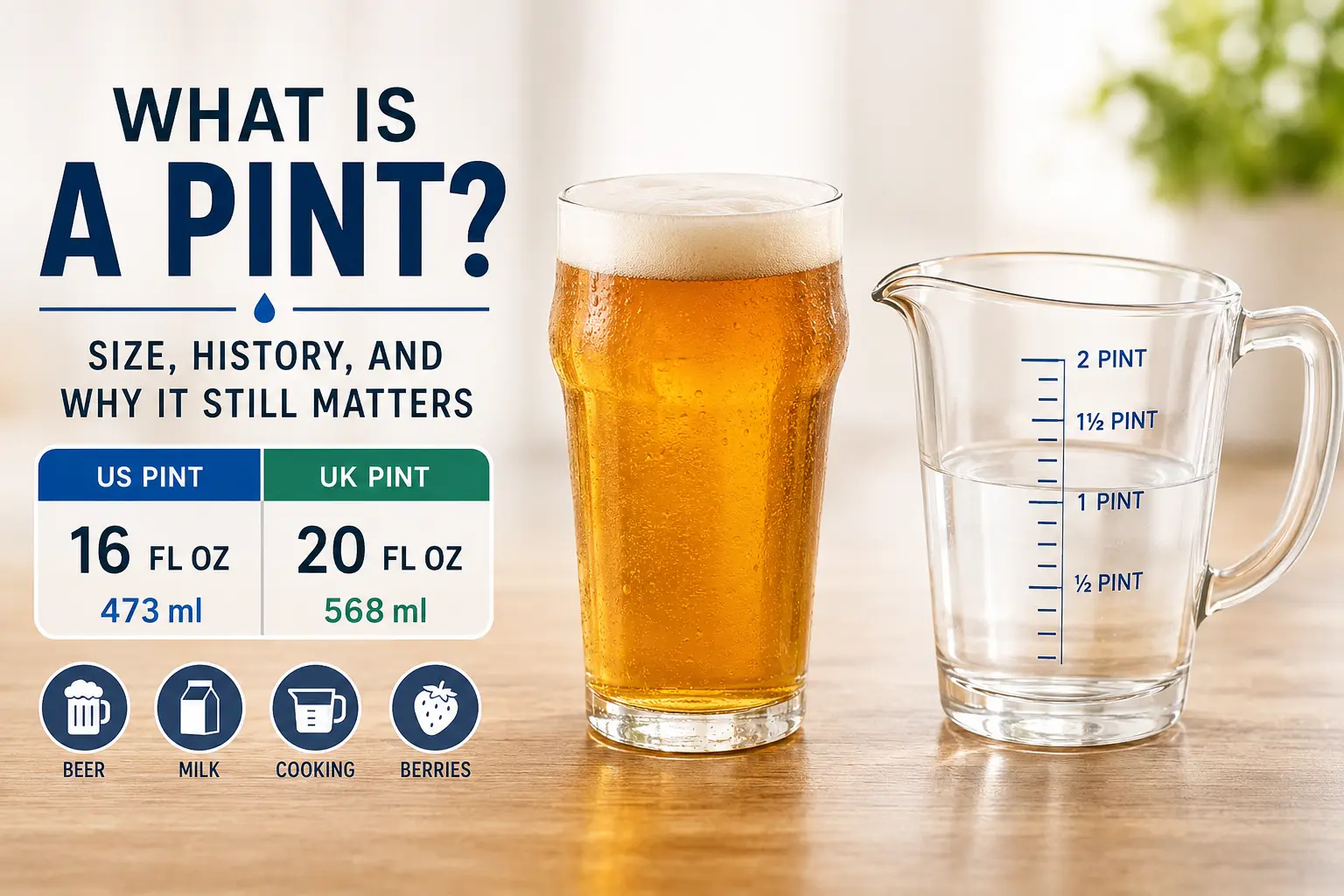
What Is a Pint? Size, History, and Why It Still Matters
- A pint is a unit of liquid volume equal to 16 fluid ounces (473 ml) in the United States and 20 fluid ounces (568 ml) in the United Kingdom.
- The US pint and the UK pint are not the same size — the British pint is about 20% larger than the American one.
- One US pint equals 2 cups, and there are 8 pints in a gallon.
- Pints are commonly used for measuring beer, milk, cream, and berries in both cooking and everyday life.
- The word “pint” comes from the Old French word pinte, and the unit has been used in Europe for over 600 years.
You’ve probably ordered a pint at a pub, grabbed a pint of strawberries at the grocery store, or seen “pt” written in a recipe. But when someone actually asks you what a pint is — how big it is, how it compares to a cup or a litre — it’s easy to draw a blank.
That’s completely normal. Pints show up constantly in daily life, but most people never stop to think about the actual number behind them. And the situation gets a little more complicated once you realize that a pint in the US and a pint in the UK are two different things entirely.
By the end of this guide, you’ll know exactly what a pint is, how it converts to other common measurements, why there are two different versions of it, and when you’ll actually need to know the difference. No fluff, no jargon — just clear answers.
A pint is a unit of liquid volume used in the imperial and US customary measurement systems. In the United States, one pint equals 16 fluid ounces or approximately 473 millilitres. In the United Kingdom and most Commonwealth countries, one pint equals 20 fluid ounces or approximately 568 millilitres. Both versions are used for measuring liquids like beer, milk, and cream, as well as some dry goods like berries.
How Big Is a Pint, Exactly?
Let’s put those numbers in perspective so they actually mean something.
A standard can of soda in the US holds 12 fluid ounces. A US pint is a bit more than that — picture a can of Coke plus a few large gulps on top. A UK pint, on the other hand, is closer to a can and a half of soda. That’s why a pint of beer at a British pub genuinely feels more filling than what you’d get at most American bars.
In the kitchen, a US pint is exactly two standard measuring cups. So if a recipe calls for one pint of cream, you’re pouring in two cups. That’s probably the most useful conversion to memorize for everyday cooking.
US Pint vs UK Pint — Side-by-Side
Here’s the full breakdown of how each pint measures up against other units:
| Measurement | US Pint | UK (Imperial) Pint |
|---|---|---|
| Fluid Ounces | 16 fl oz | 20 fl oz |
| Millilitres | 473 ml | 568 ml |
| Cups | 2 cups | 2.5 cups |
| Litres | 0.473 L | 0.568 L |
| Tablespoons | 32 tbsp | 40 tbsp |
| Pints in a gallon | 8 pints | 8 pints |
One thing that often surprises people: both systems agree that there are 8 pints in a gallon. But because the pints themselves are different sizes, a US gallon (3.785 L) and a UK gallon (4.546 L) are also different. Same ratio, different scale.
Why Does a Pint in the US Differ From a Pint in the UK?
This is one of those historical quirks that sounds confusing but actually makes sense once you know the backstory.
When the American colonies were still under British rule, they used a mix of different measurement standards — the wine gallon, the ale gallon, and several others depending on what was being measured. When Britain passed the Weights and Measures Act in 1824, it unified all of these into a single imperial system. The new imperial pint was set at one-eighth of the new imperial gallon.
The US, by then independent for nearly 50 years, didn’t adopt this change. America kept the older wine gallon as its reference, which is smaller than the imperial gallon. So the US pint (one-eighth of the US gallon) ended up smaller than the UK pint (one-eighth of the imperial gallon).
Neither country changed course after that, and the difference has stuck ever since. Today, if you’re reading an American recipe, you’re working with 16-ounce pints. A British recipe means 20-ounce pints. When in doubt, check where the recipe comes from.
Where Is a Pint Still Used Today?
Despite most of the world moving to the metric system, the pint has held on in some specific and stubborn areas of everyday life.
Beer and Cider
This is where pints are most visible. In the UK and Ireland, ordering “a pint” at a pub is completely standard — and by law, draft beer must be served in government-stamped pint glasses to ensure you’re getting the full 20 fluid ounces you paid for. In the US, “pint” on a bar menu usually means 16 ounces, though some craft beer bars now serve in different sizes without always making it obvious.
Milk and Dairy
Milk in the UK is still commonly sold by the pint — you’ll see 1-pint, 2-pint, and 4-pint bottles on supermarket shelves. In the US, milk is more often sold by the quart or gallon, but half-pint cartons are common in school cafeterias and coffee shops.
Berries and Produce
In the US, you’ll often see strawberries, blueberries, and cherry tomatoes sold in pint containers at farmers’ markets and grocery stores. Interestingly, this is actually a dry pint — a slightly different measurement (about 550 ml) used for solid goods rather than liquids. The container shape is standardized even if the precise volume differs slightly from a liquid pint.
Cooking and Baking
Older American and British recipes frequently call for pints of cream, stock, or milk. If you cook from vintage cookbooks or family recipes passed down from relatives in another country, knowing your pint conversions will save you from a lot of guesswork.
How to Convert a Pint to Other Measurements
Conversions are where most people get stuck. Here’s a practical step-by-step guide for the most common situations:
-
1
Pints to Cups (US)
Multiply the number of pints by 2. One pint = 2 cups. Two pints = 4 cups. Simple and worth memorizing for everyday cooking.
-
2
Pints to Fluid Ounces (US)
Multiply by 16. A recipe asking for half a pint needs 8 fluid ounces. A recipe needing a full pint needs 16 fluid ounces.
-
3
Pints to Millilitres
For a US pint, multiply by 473. For a UK pint, multiply by 568. Most digital kitchen scales have a ml setting, so this is straightforward once you know the starting number.
-
4
Pints to Litres
A US pint is roughly 0.47 litres. A UK pint is roughly 0.57 litres. If a recipe says “1 litre of stock,” that’s about 2.1 US pints or 1.76 UK pints.
-
5
Pints to Quarts and Gallons (US)
Two pints make one quart. Eight pints make one gallon. So if a recipe calls for a quart of chicken broth, you need exactly two pints.
Common Myths and Mistakes About Pints
❌ Myth: A pint is the same everywhere in the world
It’s not. The US pint (473 ml) and the UK imperial pint (568 ml) are genuinely different sizes. If you’re cooking from a British recipe while using US measuring tools, a “pint of cream” will leave you 95 ml short — which can actually matter in baking.
❌ Myth: A pint of something always means a liquid pint
Not always. A “pint” of strawberries at a market refers to a dry pint container, which holds roughly 550 ml by volume — slightly more than a liquid US pint. The container is standardized by shape, not by exact liquid volume.
❌ Myth: Pints are an outdated unit nobody uses anymore
In the UK and Ireland, pints are legally required for draft beer service. In the US, half-pint milk cartons are sold in millions of schools every day. The pint is alive and well — just less visible in metric-first contexts like science or medicine.
❌ Myth: A pint glass always holds exactly one pint of liquid
Not necessarily. Many “pint glasses” in the US are designed to hold a pint of beer when filled to the brim, but some bars serve with extra foam or ice. The glass size and the actual liquid amount poured are two different things. A proper UK pint glass is stamped by the government precisely to prevent short measures.
Interesting Facts and Data About Pints
I’ve always found it interesting how something as simple as a glass of beer carries centuries of legal and commercial history behind it. The pint isn’t just a number — it’s a cultural institution in countries where it’s still used, backed by actual law and tradition.
Quick Reference: Pint Conversion Cheat Sheet
Here’s everything in one place for quick scanning:
- 1 US pint = 16 fluid ounces
- 1 US pint = 2 cups
- 1 US pint = 473 ml
- 1 UK pint = 20 fluid ounces
- 1 UK pint = 568 ml
- 2 pints = 1 quart (US)
- 8 pints = 1 gallon (both US and UK)
- A dry pint (berries, produce) ≈ 550 ml
Frequently Asked Questions About Pints
Conclusion — what is a pint / What You Now Know About Pints
A pint is a unit of liquid volume with a surprisingly complicated history behind a very simple-sounding name. Here are the three things worth keeping in your memory:
First, the size depends on where you are. A US pint is 16 fluid ounces (2 cups / 473 ml). A UK pint is 20 fluid ounces (568 ml). The difference is real and matters in cooking, baking, and drinking.
Second, pints are still genuinely used every day — from pub beer orders in London to school milk cartons in Chicago to berry baskets at your local market. They haven’t gone anywhere.
Third, the divergence between US and UK pints happened in 1824 when Britain standardized its imperial system and America didn’t follow. That one historical moment explains decades of recipe confusion.
Once you know these basics, a pint stops being a vague word and becomes a precise, useful measurement you can actually rely on. If you want to go deeper, the article below on cups, quarts, and gallons ties all of this together into a complete picture of US volume measurements.