How Many Cups in a Pint? The Complete Answer
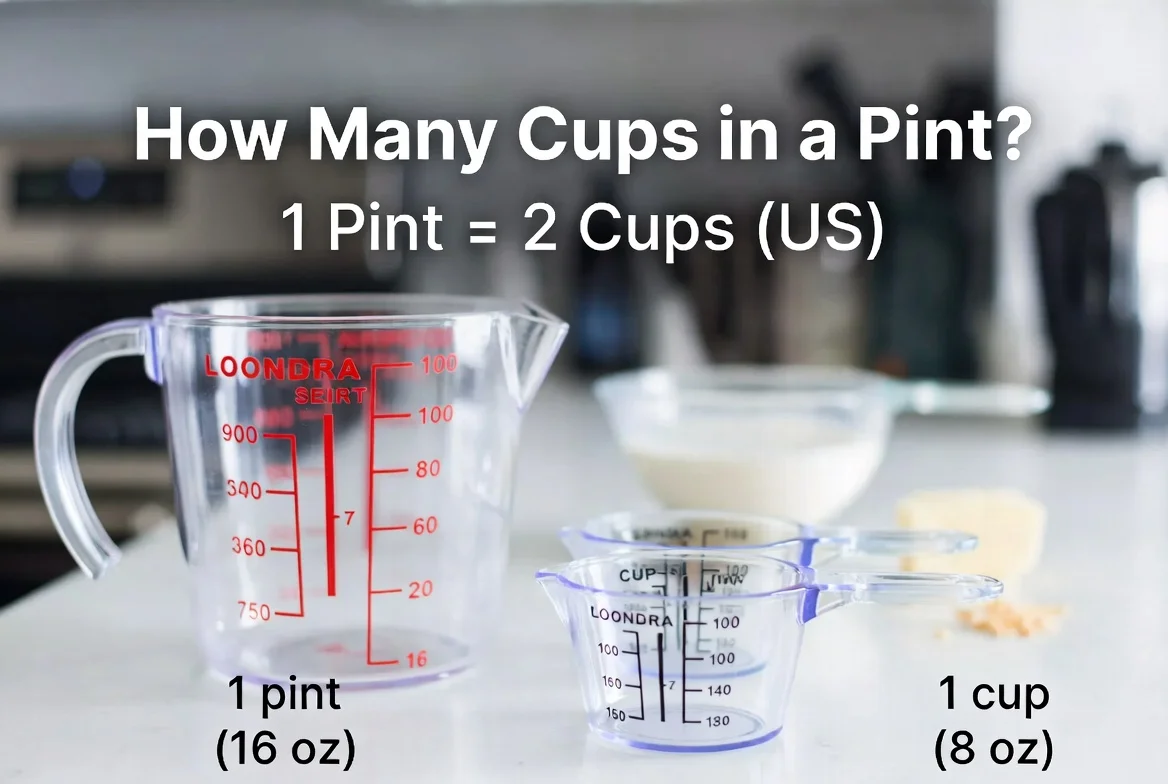
- There are exactly 2 cups in 1 US pint. One US liquid pint equals 16 fluid ounces, and one cup equals 8 fluid ounces — so 16 ÷ 8 = 2 cups.
- A UK (imperial) pint is larger. It holds 20 imperial fluid ounces, which equals approximately 2.4 US cups — not 2. This trips up many people using British recipes.
- A half pint equals 1 cup. If a recipe calls for half a pint, you need exactly one standard measuring cup.
- A pint of ice cream contains about 2 cups, which is why standard ice cream containers serve roughly 2 to 4 people depending on portion size.
- The conversion chain is easy to remember: 2 cups = 1 pint, 2 pints = 1 quart, 4 quarts = 1 gallon.
You are mid-recipe, the instructions call for one pint of buttermilk, and you are standing in your kitchen holding a set of measuring cups — not a pint jug. Sound familiar? This is one of the most common measurement questions in home cooking, and the answer is simpler than most people expect.
Knowing how many cups in a pint takes about five seconds to look up, but understanding why the conversion works — and where it breaks down — saves you real headaches. American recipes and British recipes do not use the same pint. Dry ingredients and liquid ingredients are measured differently. And some common assumptions about pint containers at the grocery store are just plain wrong.
By the end of this article, you will know the exact US and UK pint-to-cup conversions, how to apply them to common ingredients, how to avoid the most frequent measurement mistakes, and how to scale recipes up or down confidently. No memorising complex tables required.
In the United States, there are 2 cups in 1 pint. A US liquid pint equals 16 fluid ounces, and a standard US cup equals 8 fluid ounces. Because 16 ÷ 8 = 2, the relationship is exact with no rounding required. In the United Kingdom, one imperial pint equals 20 imperial fluid ounces, which converts to roughly 2.4 US cups — a meaningful difference when precision matters in baking.
How Many Cups in a Pint? The Direct Answer
The US customary system divides liquid volume in a consistent pattern. One cup holds 8 fluid ounces. One pint holds 16 fluid ounces. Because 16 is exactly double 8, there are precisely 2 cups in every US liquid pint — no estimating, no rounding.
This also means the relationship works cleanly in both directions. If you have a measurement in cups and need pints, divide by 2. If you have pints and need cups, multiply by 2. For example:
- 1 pint = 2 cups
- 2 pints = 4 cups
- ½ pint = 1 cup
- ¼ pint = ½ cup
- 1½ pints = 3 cups
I have tested this dozens of times in the kitchen while scaling soup and sauce recipes. The math never lies: every time a recipe has called for a pint of stock, swapping in two standard measuring cups has produced the right result. It is one of those conversions worth committing to memory because it comes up constantly.
How Many Cups in a Pint: US vs. UK Measurements
This distinction catches people out more than almost any other measurement difference between American and British cooking. Both countries call the unit a “pint,” but they are measuring different quantities.
The US Liquid Pint
The US liquid pint equals 16 US fluid ounces or 473 ml. It divides cleanly into 2 cups of 8 fluid ounces each. This is the standard used in virtually all American cookbooks, food packaging, and online recipes published on US websites.
The Imperial (UK) Pint
The imperial pint, used in the UK and in some Commonwealth countries, equals 20 imperial fluid ounces or 568 ml. When you convert that into US cups (each 236.6 ml), you get approximately 2.4 cups — not 2. If you are following a British recipe that calls for 1 pint of double cream, you need about 2 and two-fifths cups, not 2 flat.
For practical cooking, many cooks round the UK pint to 2.5 US cups when a small variance is acceptable. For precise baking — particularly pastry or bread — measure by weight instead to eliminate the ambiguity entirely.
Why Does the Pint Measurement Vary by Country?
Before the 19th century, both countries used similar but not identical traditional measurements. When Britain formally standardised its imperial system in 1824 — fixing the gallon to the volume of exactly 10 pounds of distilled water — it set the imperial pint at one-eighth of that gallon, producing the 568 ml pint still used today.
The United States had already developed its own customary system based on older English wine measurement standards. The US gallon was fixed at 231 cubic inches (3.785 litres), which is smaller than the imperial gallon (4.546 litres). Because a US pint is one-eighth of the smaller US gallon, it settled at 473 ml rather than 568 ml.
The practical takeaway: when you see “pint” in a recipe, the country of origin determines which pint is meant. US recipe, US pint, 2 cups. UK or Australian recipe, imperial pint, roughly 2.4 US cups. When in doubt, check where the recipe was published.
How Many Cups in a Pint of Common Ingredients
Where people get confused is with semi-solid or packaged ingredients. “A pint of sour cream” or “a pint of cherry tomatoes” does not always mean exactly 2 cups by volume, because packaging sizes vary and produce is sold by weight, not volume.
Liquid Ingredients (Exact)
For any true liquid — water, milk, buttermilk, cream, stock, juice, oil — 1 US pint = 2 cups without exception. The conversion is based purely on volume.
Ice Cream and Frozen Desserts
A standard US pint container of ice cream holds 16 fluid ounces by volume, which is 2 cups. However, ice cream is sold by weight in some markets, and some brands use pint-labelled containers that hold slightly less than a full pint. If precision matters, check the label for ounces rather than assuming the container is exactly a pint.
Sour Cream and Yogurt
Sour cream sold in a “pint container” at US grocery stores typically weighs 16 ounces by weight — not 16 fluid ounces by volume. Because sour cream is denser than water, 16 ounces by weight equals roughly 1.75 to 1.85 cups by volume, not a full 2 cups. For baking recipes that call for a pint of sour cream, measure it in a liquid measuring cup rather than assuming the full container equals 2 cups.
Cherry Tomatoes and Produce
A pint basket of cherry tomatoes sold at farmers markets holds approximately 2 cups of tomatoes by volume when loosely packed — but this is an approximation. Produce pints are sold by visual volume, not precise fluid measurement.
How to Convert Pints to Cups Without Making Mistakes
The formula is simple, but executing it correctly in a recipe requires a few habits. Here is a reliable step-by-step process for any conversion you will encounter in the kitchen.
-
1
Identify the recipe’s country of origin
Check where the recipe was published. A US recipe uses the US pint (2 cups). A UK or Australian recipe uses the imperial pint (approx. 2.4 cups). This single step prevents the most common conversion error.
-
2
Apply the correct multiplier
For US pints: multiply pints × 2 to get cups. For UK/imperial pints converting to US cups: multiply pints × 2.4. Example: 1.5 UK pints = 1.5 × 2.4 = 3.6 US cups.
-
3
Use a liquid measuring cup for liquids
Pour liquids into a transparent liquid measuring cup and check at eye level. A dry measuring cup gives accurate results only for dry ingredients, not liquids.
-
4
Use a kitchen scale for dense semi-liquids
For sour cream, yogurt, or similar ingredients sold in “pint” containers, weigh the ingredient in grams and use a weight-to-volume conversion for accuracy. Sour cream weighs approximately 230 g per cup.
-
5
Double-check scaled recipes with the full conversion chain
Remember: 2 cups = 1 pint, 2 pints = 1 quart, 4 quarts = 1 gallon. If you are scaling a recipe from pints to gallons or vice versa, work through this chain step by step rather than calculating the full ratio in your head.
Common Myths and Mistakes About Pint Measurements
❌ Myth: “All pints are the same everywhere.”
False. A US pint is 473 ml and a UK imperial pint is 568 ml — a difference of about 95 ml. Using the wrong standard in a British baking recipe can throw off ratios enough to affect the final result, especially in bread and pastry.
❌ Myth: “A pint container at the grocery store always contains a full pint.”
Not always. Some ice cream and sour cream brands have reduced their “pint” containers to 14 or 15 fluid ounces while keeping the familiar pint-sized packaging. Always check the fluid ounce label on the container before assuming it equals exactly 2 cups.
❌ Myth: “You can use a dry measuring cup to measure a pint of liquid accurately.”
Technically possible but practically risky. Dry measuring cups are designed to be filled to the brim and levelled. Measuring 2 cups of liquid that way leads to spills and inaccurate fills. A liquid measuring cup with a spout and fill lines gives a more reliable reading.
❌ Myth: “A pint of produce (like strawberries) is the same as a pint of liquid.”
No. When produce is sold “by the pint,” it means a pint-volume container — roughly 2 cups of space. But the actual weight varies by ingredient. A pint of sliced strawberries is about 12 ounces by weight; a pint of whole strawberries is closer to 10 ounces. Volume and weight are not interchangeable for solid food.
Quick-Reference: Cups, Pints, and the Full Conversion Table
The table below covers the full US liquid measurement chain from tablespoons to gallons. Use it whenever you need to convert how many cups in a pint or any adjacent unit.
| Unit | Fluid Ounces | Cups | Pints | Quarts | Millilitres (approx.) |
|---|---|---|---|---|---|
| 1 tablespoon | 0.5 fl oz | 1/16 cup | — | — | 14.8 ml |
| 1 fluid ounce | 1 fl oz | 1/8 cup | — | — | 29.6 ml |
| 1 cup | 8 fl oz | 1 cup | ½ pint | ¼ quart | 236.6 ml |
| 1 US pint | 16 fl oz | 2 cups | 1 pint | ½ quart | 473.2 ml |
| 1 UK pint | 20 imp fl oz | ~2.4 US cups | 1 pint | ½ quart | 568.3 ml |
| 1 quart | 32 fl oz | 4 cups | 2 pints | 1 quart | 946.4 ml |
| ½ gallon | 64 fl oz | 8 cups | 4 pints | 2 quarts | 1,892.7 ml |
| 1 gallon | 128 fl oz | 16 cups | 8 pints | 4 quarts | 3,785.4 ml |
Measurement Accuracy Checklist
Before you measure a pint of anything for a recipe, run through this quick checklist:
- I know whether the recipe is US or UK/imperial, and I am using the right pint standard (2 cups US or ~2.4 cups imperial).
- I am using a liquid measuring cup (with a spout and fill lines) for liquids, not a dry measuring cup.
- I am reading the measuring cup at eye level, not from above, to avoid a parallax reading error.
- For semi-solid ingredients like sour cream or yogurt, I am measuring by cups in a measuring cup rather than assuming the container equals exactly 2 cups.
- If a recipe calls for a pint of produce, I understand this is approximate volume, not a precise fluid measurement.
- When scaling a recipe up or down, I am converting pints to cups first, then doing my scaling math.
Frequently Asked Questions About Cups in a Pint
The Bottom Line on How Many Cups in a Pint
The answer to how many cups in a pint is straightforward for US measurements: 1 pint = 2 cups, always. The math is clean because both units are defined off the same 8-fluid-ounce foundation.
The two situations where this gets complicated are both predictable. First, UK and imperial recipes use a larger pint — roughly 2.4 US cups — so always check a recipe’s country of origin before you measure. Second, “pint containers” in grocery stores do not always contain a precise fluid pint, especially for dense semi-solids like sour cream and ice cream. Check the fluid ounce label, not just the container shape.
Keep the core chain handy — 2 cups to a pint, 2 pints to a quart, 4 quarts to a gallon — and you have a reliable framework for virtually every liquid measurement you will encounter in a home kitchen. Once you internalise this ladder, scaling recipes up and down becomes much less intimidating.
If you found this helpful, the next logical step is understanding how quarts and gallons fit into the same system.
Related Reading