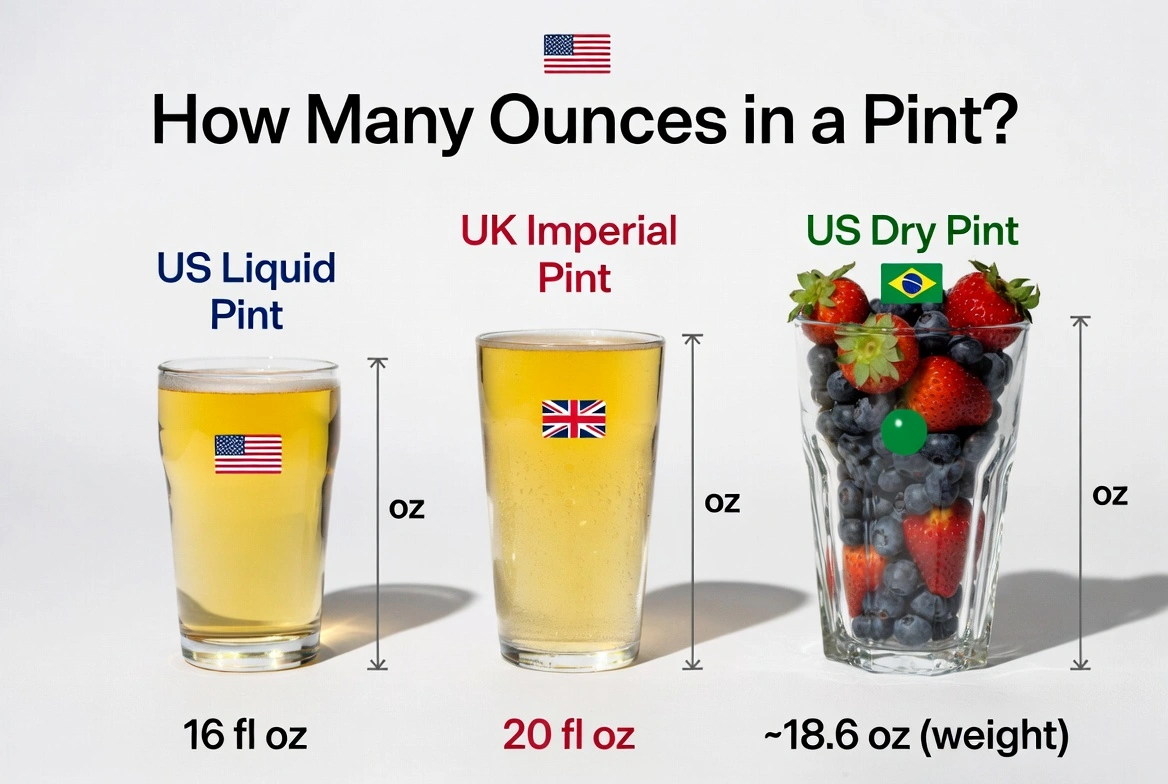
- US liquid pint = 16 fluid ounces. This is the standard in American recipes, restaurants, and beer servings.
- UK (imperial) pint = 20 fluid ounces. A British pint is 25% larger than an American one — relevant for beer, recipes, and imported products.
- US dry pint = 18.6 ounces by weight (not fluid ounces). Used for produce like blueberries and strawberries, not for liquids.
- Quick conversion: To convert pints to fluid ounces, multiply by 16 (US) or by 20 (UK). To go the other way, divide fluid ounces by 16 or 20.
- Why it matters: Using the wrong pint measurement in a recipe or purchase can result in a 25% error — enough to ruin a dish or significantly underfill a drink order.
Here is a question that trips up more people than you would expect: you are following a British recipe that calls for a pint of cream, so you measure out 16 fluid ounces — the standard US pint — and assume you are done. But the recipe calls for a UK pint, which is 20 fluid ounces. You just used 20% less cream than intended, and the sauce will not come together correctly.
Understanding how many ounces in a pint sounds like a simple one-number answer, but the correct answer depends on where you are, what measurement system you are using, and whether you are measuring a liquid or a dry ingredient. There are actually three different “pint” definitions in active use today, and confusing them causes real problems in cooking, bartending, and everyday shopping.
By the end of this guide, you will know the exact ounce values for every pint definition, how to convert between them confidently, and how to spot which pint a recipe or product label is referring to.
A pint is a unit of volume measurement used for both liquid and dry ingredients. In the United States, one liquid pint equals 16 fluid ounces and is part of the US customary system of measurement. In the United Kingdom and other countries using the imperial system, one pint equals 20 fluid ounces. A US dry pint — used for measuring produce and dry goods — equals approximately 18.6 ounces by weight and is distinct from both liquid pint definitions.
How Many Ounces in a Pint in the United States?
The US liquid pint sits in the middle of the US customary volume scale. Two cups make one pint. Two pints make one quart. Four quarts make one gallon. So a US pint is one-eighth of a gallon, or 473.18 milliliters in metric terms.
You will encounter the 16-ounce US pint constantly in everyday life. A standard pint of beer at an American bar is 16 oz. A pint of ice cream at a US grocery store is 16 oz. A pint of blueberries, a pint of cherry tomatoes, a pint of sour cream — all 16 oz in the American system.
US Pint Volume Breakdown
Here is how the US pint relates to other common measurements you likely use every day:
- 1 US pint = 16 fluid ounces
- 1 US pint = 2 cups (each cup = 8 fl oz)
- 1 US pint = 4 gills (an older unit, still used in some spirits contexts)
- 1 US pint = 32 tablespoons
- 1 US pint = 96 teaspoons
- 1 US pint = 473.18 milliliters
How Many Ounces in a UK Pint? The Imperial Measurement Explained
The UK pint is 25% larger than the US pint. This is not a rounding difference or a measurement quirk — it is a formally distinct unit with a different legal definition. When a British recipe, pub menu, or imported product mentions a “pint,” it means 20 fluid ounces unless explicitly stated otherwise.
In the UK, the pint remains a legally protected unit for beer and cider sold on draft. Under the Weights and Measures Act 1985, draft beer in UK pubs must be served in pints or half-pints — and those must meet the 20 fl oz imperial definition. This is enforced by Trading Standards officers and taken seriously by both consumers and regulators.
UK Imperial Pint Volume Breakdown
- 1 UK pint = 20 imperial fluid ounces
- 1 UK pint = 4 gills (each gill = 5 imperial fl oz)
- 1 UK pint = 568.26 milliliters
- 2 UK pints = 1 UK quart
- 8 UK pints = 1 UK gallon
What Is a US Dry Pint and How Many Ounces Does It Contain?
The dry pint is the measurement that confuses people most. It sounds like it should equal 16 ounces (the same as a liquid pint), but it does not. A dry pint is a volume measurement, not a weight measurement, and it was historically used for loose, dry goods that could not be accurately measured by liquid volume methods.
When you buy a pint of strawberries, a pint of cherry tomatoes, or a pint of dried beans at a US grocery store or farmers market, you are getting a US dry pint container. The container holds approximately 550.61 milliliters of volume — more than a US liquid pint (473 ml) but less than a UK pint (568 ml).
Why the Dry Pint Is Different
The dry pint emerged from agricultural trade in the 19th century United States. Farmers and merchants needed a consistent way to sell loose produce — berries, corn, grain — without weighing each portion individually. The dry pint container standardized the volume of these sales. It was never intended for liquid measurement and should not be used interchangeably with the liquid pint in recipes.
How Do You Convert Ounces to Pints — and Pints to Ounces?
Conversions between ounces and pints come up constantly in cooking, bartending, and shopping. The steps below cover the most common scenarios you will encounter.
-
1
Identify which pint definition applies
Check whether the recipe, label, or context is US or UK. American recipes use 16 fl oz pints. British, Irish, and many Australian recipes use 20 fl oz pints. When in doubt, check the publication’s country of origin or look for milliliter equivalents — 473 ml = US pint; 568 ml = UK pint.
-
2
Convert fluid ounces to US pints
Divide the number of fluid ounces by 16. Example: 48 fl oz ÷ 16 = 3 US pints. Example: 8 fl oz ÷ 16 = 0.5 pints (half a pint).
-
3
Convert fluid ounces to UK pints
Divide the number of fluid ounces by 20. Example: 60 fl oz ÷ 20 = 3 UK pints. Example: 40 fl oz ÷ 20 = 2 UK pints. Remember: UK fluid ounces are slightly different from US fluid ounces, but for everyday cooking purposes the difference (about 4%) is negligible.
-
4
Convert US pints to fluid ounces
Multiply pints by 16. Example: 2.5 US pints × 16 = 40 fl oz. Example: 0.75 pints × 16 = 12 fl oz. This direction is especially useful when scaling recipes up or down.
-
5
Convert US pints to metric (milliliters)
Multiply US pints by 473.18. Example: 3 pints × 473.18 = 1,419.5 ml (approximately 1.42 liters). For quick mental math, 1 US pint ≈ 475 ml is close enough for most cooking applications.
Why Are US and UK Pints Different Sizes?
This is genuinely interesting history that explains a measurement discrepancy millions of people encounter every day without knowing the cause.
When the American colonies were part of Britain, two different gallons were in common use: the wine gallon (231 cubic inches) and the ale gallon (282 cubic inches). After independence, the United States chose the wine gallon as its standard liquid gallon. Britain later standardized on the imperial gallon (277.4 cubic inches) in 1824, which sits between the two older measures.
Since a pint is defined as one-eighth of a gallon, the two systems produced different pint sizes: the US gallon (231 cubic inches ÷ 8) gives a 28.875 cubic inch pint, which equals 16 fluid ounces. The UK imperial gallon (277.4 cubic inches ÷ 8) gives a 34.67 cubic inch pint, which equals 20 imperial fluid ounces.
Both systems are internally consistent. The confusion arises only when you cross between them — which happens constantly with imported food products, international recipes, and travel.
Common Mistakes and Myths About Pint Measurements
❌ Myth: A pint is always 16 ounces
This is only true for the US liquid pint. A UK pint is 20 fluid ounces, and a US dry pint is approximately 18.6 ounces by weight. Assuming all pints equal 16 oz is one of the most common cooking errors when working with British or Irish recipes, and it leads to measurably different results.
❌ Myth: A pint of water weighs exactly one pound
The saying “a pint’s a pound, the world around” is a rough mnemonic, not an exact fact. One US liquid pint of water weighs approximately 1.04 pounds (16.69 ounces), not exactly 16 ounces (1 pound). The approximation works well enough for simple cooking estimates, but it fails in baking, where precision matters. For exact weights, always use a scale.
❌ Myth: Fluid ounces and weight ounces are the same
A fluid ounce measures volume. A weight ounce measures mass. For water, they are close (1 fl oz of water ≈ 1.04 oz by weight) because water has a density close to 1. But for heavier liquids like honey or lighter ones like vegetable oil, the difference is significant. A fluid ounce of honey weighs about 1.5 oz. Always distinguish between the two when reading a recipe or label.
❌ Myth: US and UK fluid ounces are the same size
They are close but not identical. One US fluid ounce = 29.57 ml. One UK imperial fluid ounce = 28.41 ml. The difference is about 4%, which is irrelevant for casual use but can matter in precise scientific, pharmaceutical, or commercial contexts. When a British recipe gives a fl oz measurement, the technically correct approach is to use UK fluid ounces — though most home cooks substitute US fl oz without noticeable impact.
Key Measurement Facts Worth Knowing
Pint Measurement Quick-Reference Table
| Pint Type | Fluid Ounces | Milliliters | Cups (US) | Common Use |
|---|---|---|---|---|
| US Liquid Pint | 16 fl oz | 473.18 ml | 2 cups | US cooking, beer, dairy |
| UK Imperial Pint | 20 fl oz | 568.26 ml | 2.5 US cups | UK/Irish cooking, draft beer |
| US Dry Pint | ~18.6 oz (weight) | 550.61 ml | N/A (dry volume) | Produce, berries, dry goods |
Common Pint-to-Ounce Conversions at a Glance
| Pints (US) | Fluid Ounces (US) | Pints (UK) | Fluid Ounces (UK) | Milliliters |
|---|---|---|---|---|
| ¼ pint | 4 fl oz | ¼ pint | 5 fl oz | 118 ml / 142 ml |
| ½ pint | 8 fl oz | ½ pint | 10 fl oz | 237 ml / 284 ml |
| 1 pint | 16 fl oz | 1 pint | 20 fl oz | 473 ml / 568 ml |
| 2 pints | 32 fl oz | 2 pints | 40 fl oz | 946 ml / 1,136 ml |
| 4 pints | 64 fl oz | 4 pints | 80 fl oz | 1,893 ml / 2,273 ml |
Frequently Asked Questions About Ounces in a Pint
What You Now Know About Ounces in a Pint
The answer to how many ounces in a pint is not a single number — it is three, depending on context. A US liquid pint is 16 fluid ounces, the standard for American cooking and beverages. A UK imperial pint is 20 fluid ounces, and that 4-ounce difference has real consequences any time you cross between measurement systems. And the US dry pint — used for produce and bulk dry goods — holds approximately 18.6 ounces by volume, a third definition that most people never think to question at the grocery store.
The practical takeaway is straightforward: whenever you encounter a pint measurement, take five seconds to confirm which system it belongs to. Check the recipe’s country of origin, look for milliliter equivalents on product labels, or simply remember 16 = US liquid, 20 = UK imperial. Those two numbers cover the vast majority of situations you will ever face.
Measurement conversions become second nature quickly once you understand the underlying system. From here, exploring cups-to-quarts and ounces-to-gallons conversions will fill in the rest of the picture.